
Buying a Home in Maricopa County: Gilbert vs Chandler, AZ
The Phoenix metro keeps pushing east, and if you've been shopping in the East Valley, you've probably already narrowed things down to these two. Gilbert and Chandler sit right next to each other in Maricopa County, separated by Price Road, and from the freeway they can look nearly identical. Same access to the broader region, same master-planned DNA, same pull toward the major job centers. It is easy to assume living in Gilbert offers the exact same lifestyle as Chandler.
But they're not the same purchase. Once you start looking at median prices, tax structures, and how old the housing stock actually is, the differences become real enough to matter. What follows is a straightforward comparison of the data so you can figure out which side of that border fits your budget and your commute.
Home Prices and Architecture
Gilbert's median sale price is currently around $579,000, with homes averaging 46 days on the market and roughly 1,001 active listings citywide - that works out to about 2.9 months of supply. Chandler runs a bit cheaper, with median sold prices for single-family homes sitting between $550,000 and $570,000 through the spring and summer of 2026. Gilbert's sale-to-list ratio is 98.3%, meaning sellers are getting very close to what they're asking. Both markets see consistent demand, and the price gap between them has a lot to do with how the East Valley was built - development moved from west to east over the decades, so Chandler's housing stock is generally older.
Neighborhood Styles and Layouts
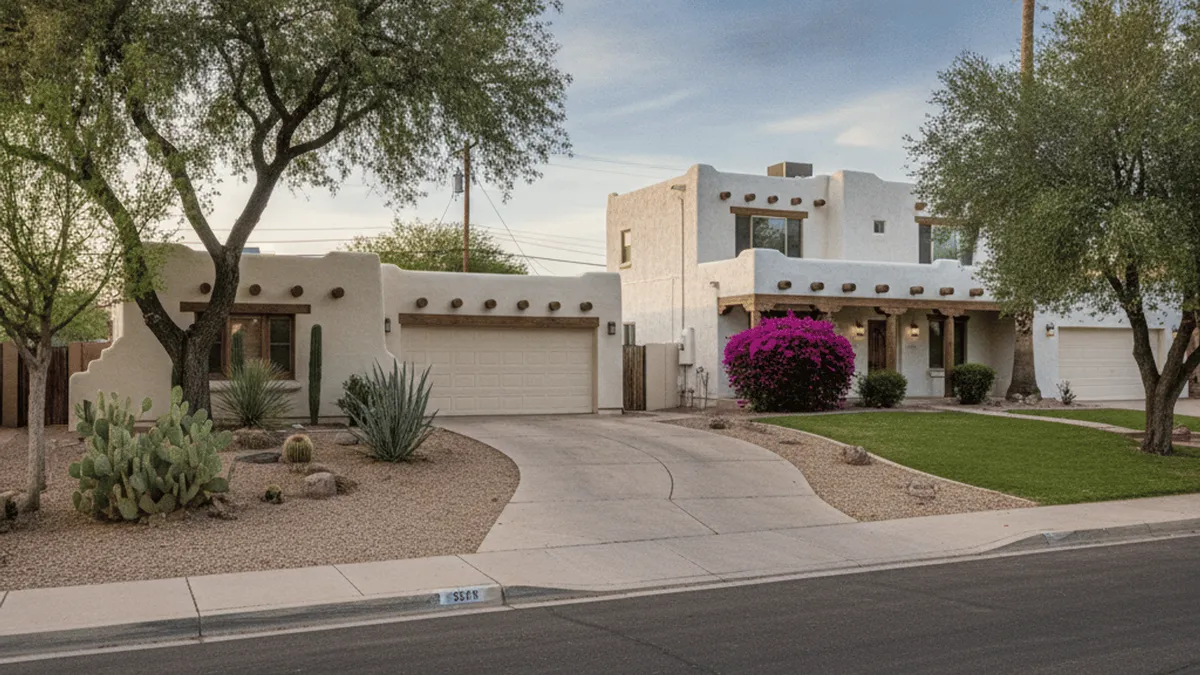
Gilbert is mostly newer construction. You'll see master-planned suburban subdivisions with stucco-exterior Southwest and contemporary ranch designs, plus newer agri-urban and farmhouse-style developments - Agritopia being the well-known example.
Chandler reflects its earlier population boom. There are more 1980s and 1990s ranch homes, Santa Fe and pueblo-influenced designs, and a small historic bungalow district near downtown that you simply won't find anywhere else in the surrounding newer suburbs.
Homeowners Association Fees
Mandatory HOAs are standard in both cities. The master-planned communities that define most of the East Valley were built with these organizations in place to manage landscaping, common areas, and amenities, and that's still the norm today.
If you're hoping to avoid HOA dues entirely, your options are slim. Non-HOA neighborhoods exist mainly in the older, central corridors of Chandler or on the more rural legacy lots in Gilbert - outside of those pockets, you should budget for monthly or quarterly fees.
Local Property Taxes and Expenses
Property taxes in Maricopa County are a layered calculation - city, school district, and county levies all stack on top of each other. Chandler's combined primary and secondary city property tax rate runs roughly $1.08 per $100 of assessed value for the 2025-26 fiscal year, though that city portion accounts for only about 11% of a typical homeowner's total bill. Schools and county services drive most of what you actually pay. Chandler's effective residential rate averages around 0.47%, which produces a median annual tax bill near $1,984.
Gilbert works a little differently, and it's worth understanding before you start estimating your escrow.
How Tax Rates Compare
Gilbert doesn't levy a primary property tax. Instead, it relies on a secondary property tax used exclusively to pay voter-approved bonds. Add in the county and school district levies and the effective residential rate in Gilbert ranges from 0.46% to roughly 0.9%, depending on your specific ZIP code. The median annual tax bill in Gilbert sits at approximately $2,131.
The overall burden is comparable between the two cities, but the exact number on your tax bill will move based on which school district boundaries your property falls within - so check that before you get too attached to a specific neighborhood.
Commuting Across the East Valley
The freeway network is essentially shared. State Route 202, the SanTan Freeway, loops through both cities and connects directly to the broader interstate system. U.S. Route 60, the Superstition Freeway, runs along the northern edge of the area and gets you to Tempe and downtown Phoenix. State Route 87 - Arizona Avenue - runs north to south through Chandler specifically.
On top of the freeways, major arterials including Baseline, Elliot, Warner, Ray, and Williams Field run east to west across both municipalities in a grid. You can move between cities for local trips without touching a freeway at all.
Reaching Major Employment Hubs
Chandler is itself a significant employment center. Large semiconductor and technology manufacturing facilities, including Intel, operate here, and buyers working in those industries tend to focus their search along the Price Road Corridor to keep their commute short.
For everyone else, the drive times are roughly even from either city. Downtown or midtown Phoenix - finance, government work - means taking US 60 or the Loop 202. Same story for Tempe and Arizona State University, or for commuters heading to Scottsdale and the Sky Harbor Airport area.
Parks, Shopping, and Recreation
Neither city is lacking on this front. Gilbert's primary retail hub is the SanTan Village shopping district, right off Loop 202. Chandler residents tend to gravitate toward the Chandler Fashion Center, a large regional mall with plenty of additional retail and dining surrounding it.
Both cities have also put real effort into their downtowns. The Heritage District in Downtown Gilbert and walkable Downtown Chandler both offer concentrated clusters of local restaurants and businesses - a different feel from the surrounding suburban grid.
Trails and Outdoor Spaces
Gilbert has the Riparian Preserve at Water Ranch for bird watching and walking, Freestone Park, and an extensive multi-use path network running along the local canals. For serious hiking, residents typically drive south to the San Tan Regional Park.
Chandler's outdoor options include Tumbleweed Park and Veterans Oasis Park, which has nature trails and an environmental education center. The Paseo Trail system follows the Consolidated Canal and gives Chandler residents miles of paved paths for running and cycling.
Frequently Asked Questions
Is it currently more expensive to buy a house in Gilbert, AZ compared to Chandler?
Yes. Gilbert's median sale price is currently around $579,000, while Chandler's median sold prices generally land between $550,000 and $570,000. Chandler's slightly older housing stock is the main reason buyers tend to find a lower entry point there.
How do property taxes and average HOA fees compare between Gilbert and Chandler neighborhoods?
The effective property tax rates are close - Chandler averages around 0.47% and Gilbert ranges from 0.46% to 0.9% depending on the school district. HOA fees are common in both cities since most neighborhoods are master-planned communities that require monthly or quarterly dues for common area maintenance.
Which city's real estate market is appreciating faster for long-term home value, Gilbert or Chandler?
Recent data shows modest year-over-year price adjustments in both markets rather than strong appreciation. Gilbert's median sale price saw a minor decrease of roughly 0.6% recently, while Chandler home values have trended slightly downward by about 1.8% over the past year.
Is Gilbert or Chandler a better fit for families looking for top-rated public school districts?
Both cities are served by multiple public school districts, and those district levies make up the largest share of a homeowner's tax bill in either municipality. You'll want to pull up the boundary maps for the Chandler Unified School District and Gilbert Public Schools to see which specific neighborhoods align with your preferences.
Will I typically find larger lot sizes in older Chandler neighborhoods or newer master-planned communities in Gilbert, AZ?
Older Chandler neighborhoods from the 1980s and 1990s often feature traditional ranch layouts with different lot dimensions than modern construction. Gilbert's newer master-planned communities, including its farmhouse-style developments, follow more contemporary suburban zoning and density standards.
Which city offers a better daily commute to downtown Phoenix and major East Valley tech employers?
It depends on where you're actually going. Chandler offers a shorter, more direct commute to the semiconductor and tech manufacturing hubs within its own borders, including the Intel campuses. For downtown Phoenix, the drive times are similar from both cities via U.S. Route 60 or the Loop 202 freeway.